Contract Upholstery Fabric Performance: Wyzenbeek, Martindale, TB 117-2013
How to read contract upholstery performance specs: Wyzenbeek double rubs, Martindale cycles, ACT guidelines, CAL TB 117-2013, BS 5852 and EN 1021, cleaning codes.
Short answer: For restaurant and hotel seating in North America, the widely used ACT voluntary guidelines call for at least 15,000 Wyzenbeek double rubs (or 20,000 Martindale cycles) for general contract upholstery and 30,000 double rubs (or 40,000 Martindale cycles) for heavy-duty use, plus light-fastness, crocking, pilling, seam slippage, tensile strength and a flammability standard such as CAL TB 117-2013. Wyzenbeek and Martindale results cannot be converted into each other. In the UK and EU, specify flammability to BS 5852 (via BS 7176) or EN 1021-1/-2 as required, and confirm the exact requirement with the fire consultant.
Abrasion figures are the number everyone quotes and the one least understood. A fabric can post an impressive rub count and still pill, fade at a window or slip at the seams within a year of service. This guide explains the tests that matter for contract seating and how we at Spec Seating (a line by EASEN Commercial Furniture) suggest writing them into a specification.
What do Wyzenbeek and Martindale actually measure?
Both are abrasion tests, but they work differently:
- Wyzenbeek (ASTM D4157) rubs the fabric back and forth in a straight line with a cotton duck or wire screen abradant. Results are reported in double rubs - one forward and back movement. It is the method most used in North America.
- Martindale (ASTM D4966 in the US; ISO 12947 / EN ISO 12947-2 in Europe) rubs the fabric in a Lissajous figure-of-eight pattern against a standard wool abradant. Results are reported in cycles. It is the method most used in the UK and Europe.
Because the motion, abradant and end-point definitions differ, there is no reliable conversion between double rubs and cycles. A fabric data sheet should state the method; treat any number without a method as unverified.
Also note that very high abrasion counts beyond the heavy-duty threshold rarely translate into proportionally longer life. In practice, seating usually fails first by pilling, seam slippage, staining or fading rather than by abrasion wear-through.
What do the ACT guidelines recommend for upholstery?
The Association for Contract Textiles (ACT) publishes voluntary performance guidelines that many North American specifiers use as a baseline. For upholstery, the commonly cited thresholds are:
| Property | Test method | Upholstery guideline |
|---|---|---|
| Abrasion, general contract | ASTM D4157 Wyzenbeek | 15,000 double rubs |
| Abrasion, general contract | ASTM D4966 Martindale | 20,000 cycles |
| Abrasion, heavy duty | ASTM D4157 Wyzenbeek | 30,000 double rubs |
| Abrasion, heavy duty | ASTM D4966 Martindale | 40,000 cycles |
| Colorfastness to light | AATCC 16 (Option 1 or 3) | Grade 4 minimum at 40 hours |
| Colorfastness to crocking | AATCC 8 | Dry grade 4, wet grade 3 minimum |
| Physical properties - pilling | ASTM D3511 or D4970 | Class 3 minimum |
| Physical properties - breaking strength | ASTM D5034 (grab) | 50 lb minimum in warp and weft |
| Physical properties - seam slippage | ASTM D4034 | 25 lb minimum in warp and weft |
| Flammability | CAL TB 117-2013, Section 1 | Pass |
Guidelines are periodically reviewed, so check the current ACT documentation when writing the specification. Restaurant banquettes and bar seating usually justify heavy-duty abrasion; hotel guestroom lounge chairs often do not.
Which flammability standards apply to upholstered seating?
Flammability is jurisdiction-specific and often occupancy-specific. Use the table as orientation, not as a compliance determination:
| Market | Common requirement | What it tests |
|---|---|---|
| United States | CAL TB 117-2013 | Smolder (cigarette) resistance of cover fabrics, barriers, fillings and decking materials |
| United States | NFPA 260 / ASTM E1353 | Cigarette ignition resistance of upholstered furniture components, referenced in some codes and specifications |
| United Kingdom, contract | BS 5852 ignition sources, by hazard level in BS 7176 | Smolder and flaming ignition of cover/filling combinations; medium hazard commonly calls for sources 0, 1 and crib 5 |
| European Union | EN 1021-1 and EN 1021-2 | Cigarette and match-flame equivalent ignitability; some countries and occupancies add national tests |
Notes:
- In the US, TB 117-2013 began as a California standard and federal law has since adopted it as a national flammability standard for upholstered furniture (16 CFR part 1640). Applicability to specific contract items should be confirmed with your consultant.
- Some US jurisdictions, high-occupancy venues and institutional projects require additional open-flame testing. Ask the fire marshal or fire protection engineer what applies to the venue.
- In the UK, the domestic Furniture and Furnishings (Fire) (Safety) Regulations are separate from contract requirements; contract projects usually specify BS 7176 hazard levels.
- Flammability is a property of the combination of cover, interliner and filling, not of the fabric alone. A fabric that passes on one foam can fail on another.
We specify foams, barriers and fabrics to meet the destination market's rules on request and supply test reports for specific items where available.
What do cleaning codes mean?
| Code | Meaning | Implication for restaurants |
|---|---|---|
| W | Water-based cleaners | Easiest for daily spot cleaning |
| S | Solvent-based cleaners only | Requires trained cleaning staff |
| W/S | Either water- or solvent-based | Flexible |
| X | Vacuum or light brush only | Unsuitable for dining seating |
For food service, specify fabrics that tolerate water-based cleaning and, where needed, disinfectants. Check with the mill whether bleach or quaternary ammonium cleaners are permitted; some finishes and colors are not.
How to write fabric performance into a specification
- Name the method with every number. "30,000 double rubs, ASTM D4157 (cotton duck)", not "heavy duty".
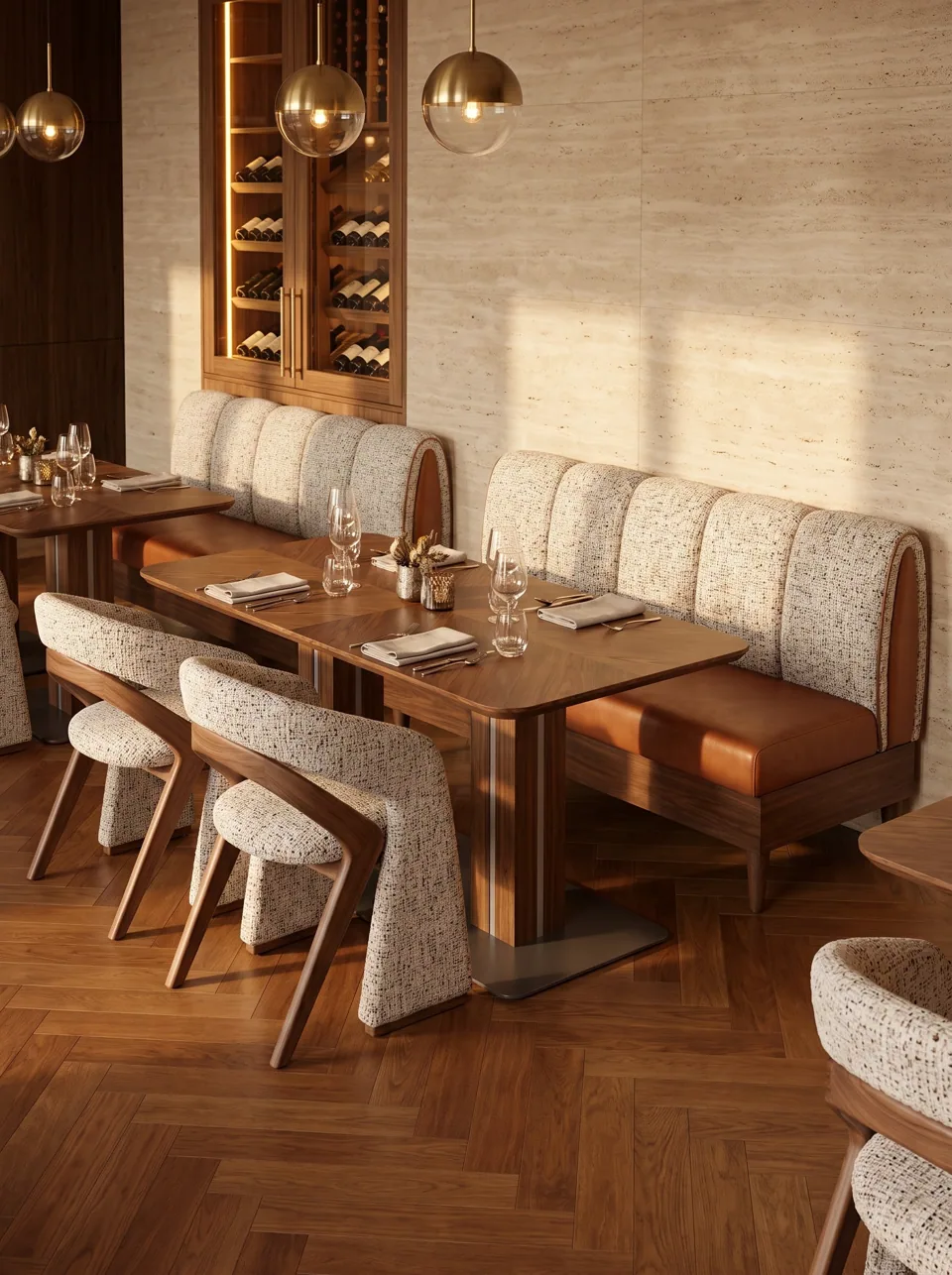
- Set the duty level by location. Heavy duty for banquettes, bar stools and high-turnover dining chairs; general contract for low-use lounge seating.
- Add the physical properties. Pilling, seam slippage and breaking strength prevent the most common early failures.
- Specify light-fastness for window positions. Banquettes along glazing see far more UV than interior seats.
- Define flammability as a tested combination. Name the standard and require test reports for the cover/filling combination where the jurisdiction requires it.
- Specify backing where needed. Loose weaves and some velvets need a backing for dimensional stability on tight upholstery and channels.
- State the cleaning code required. W or W/S for most food service.
- Request data sheets at submittal. Verify the fabric delivered matches the one specified.
Common mistakes
- Chasing rub counts. A 100,000 double-rub fabric with poor pilling performance will look worse, sooner, than a 30,000 double-rub fabric with good pilling and seam slippage results.
- Comparing Wyzenbeek with Martindale. The numbers are not interchangeable.
- Assuming a fabric is "fire rated". Flammability depends on the tested assembly and the standard; ask which test and on what filling.
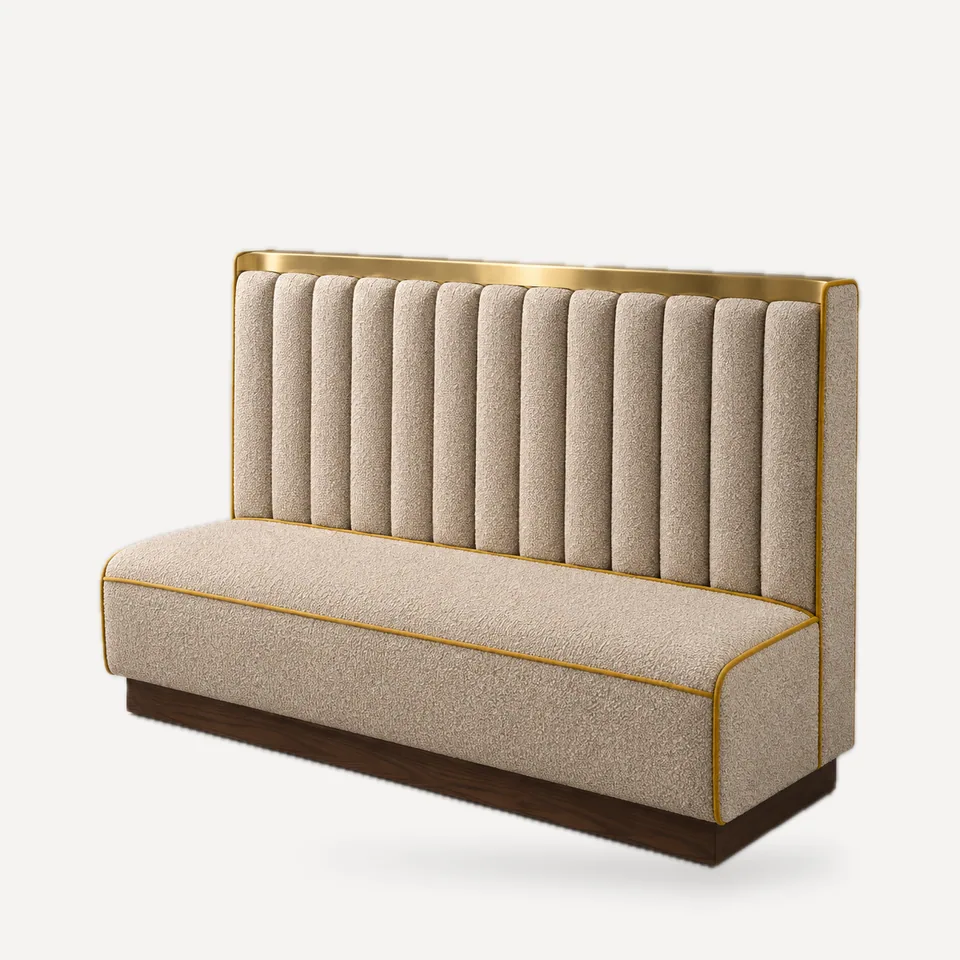
- Ignoring curves and channels. Stiff vinyls and heavily backed fabrics can wrinkle on tight radii and narrow channels; review with the manufacturer.
- Selecting an X-code fabric for dining seating, which cannot be cleaned with water.
- Forgetting the welt. Contrast welt fabric takes the hardest abrasion on the front edge and must meet the same performance level.
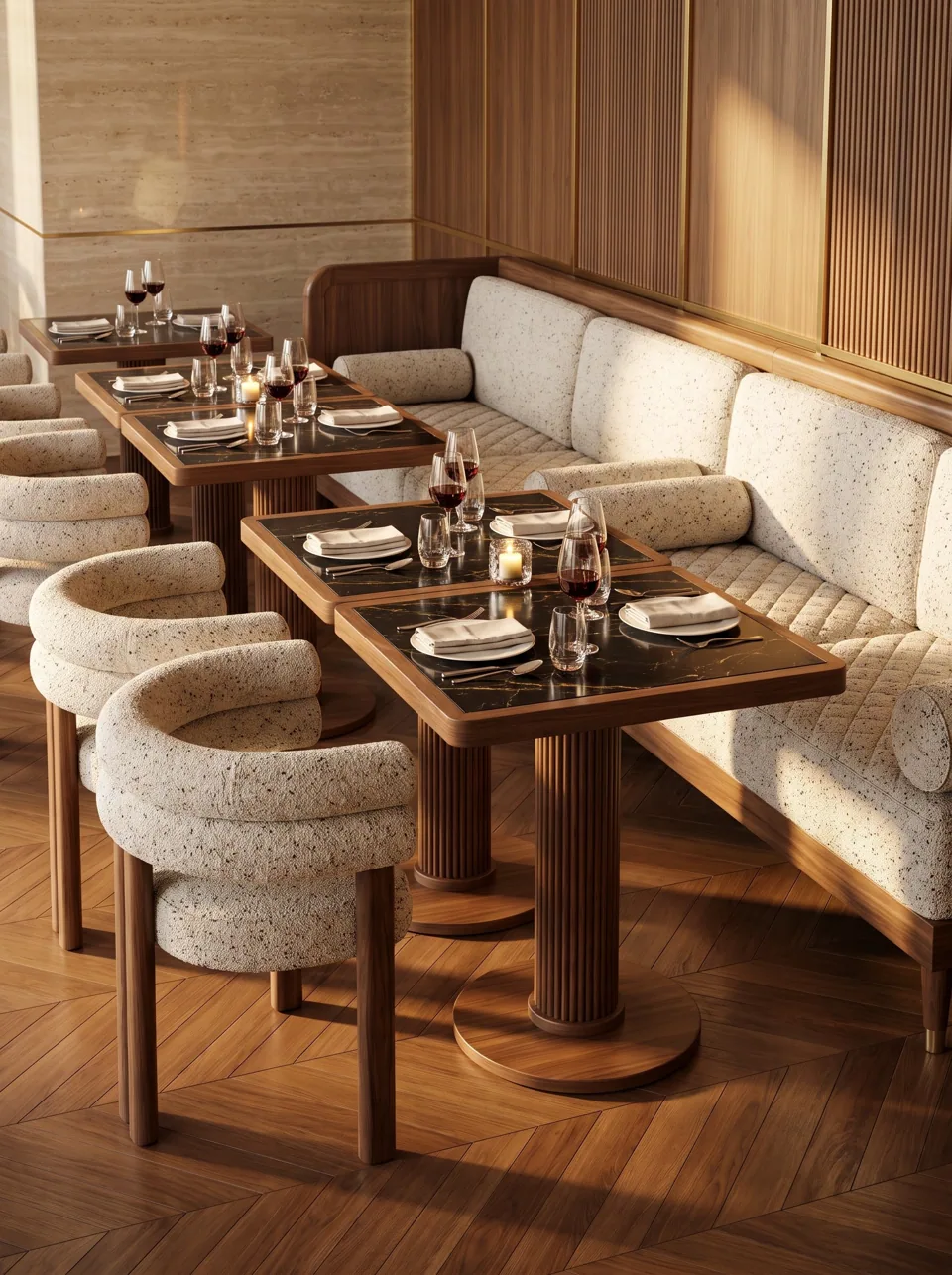
Our COM/COL chairs and wall banquettes are drawn with the selected fabric in mind; for example, the SB-102 Diamond-Quilted Banquette works best with fabrics that have some give.
FAQ
How many double rubs does restaurant seating need?
Most specifiers use the ACT heavy-duty guideline of 30,000 double rubs (ASTM D4157) for restaurant banquettes and dining chairs, with matching pilling, seam slippage and strength requirements. Higher counts add little unless the other properties are also strong.
Can I convert Martindale cycles into Wyzenbeek double rubs?
No. The tests use different motions, abradants and end points. Specify the method that matches your market and ask the mill for results in that method.
Does CAL TB 117-2013 apply to restaurant furniture?
TB 117-2013 is widely specified for upholstered seating in the US and has been adopted federally for upholstered furniture. Some venues and jurisdictions require additional tests. Confirm the requirement for your occupancy with the fire marshal or your fire protection engineer.
Is faux leather (vinyl or PU) better than fabric for restaurants?
Coated fabrics clean easily and resist spills, which suits high-turnover dining. They vary widely in abrasion, cold-crack and hydrolysis resistance, so ask for those test results, and check that the coated fabric suits curves and channels in the design.
Send your drawings package or FF&E schedule and we will return a scope review, quote and first shop drawings. Partial packages are fine; tell us what is still in design.
Request a quote