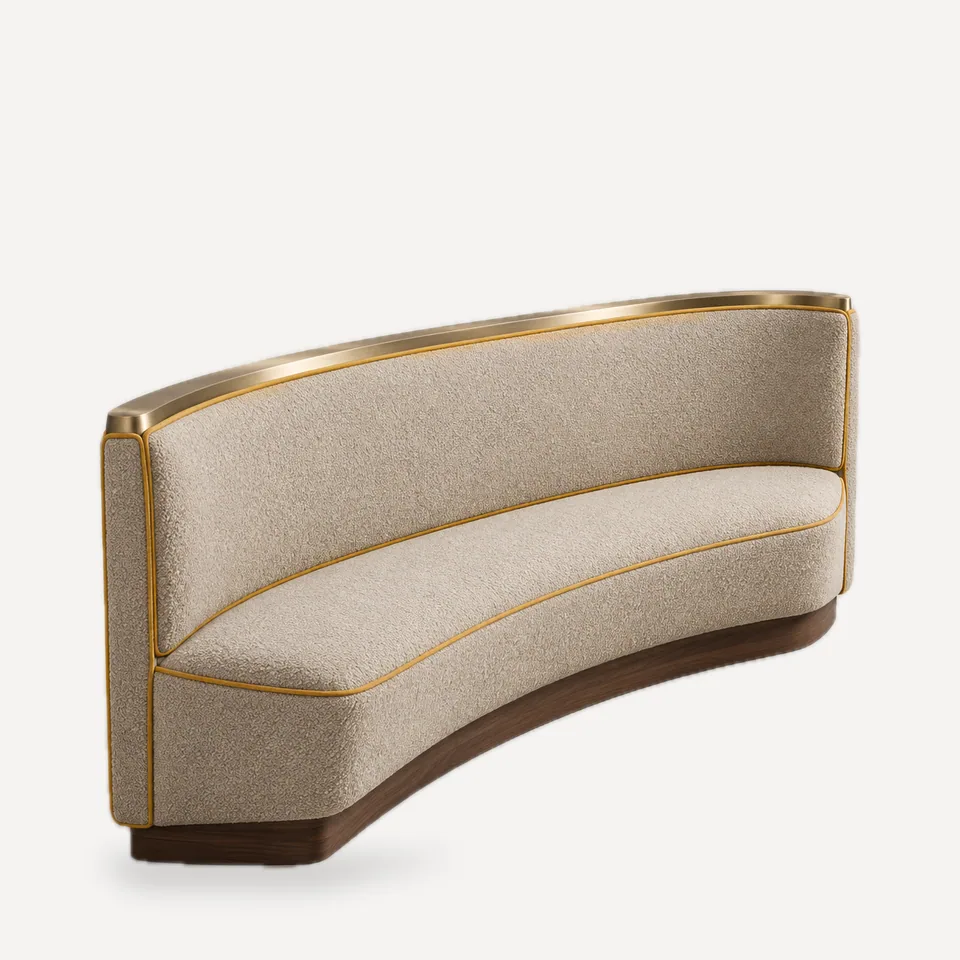
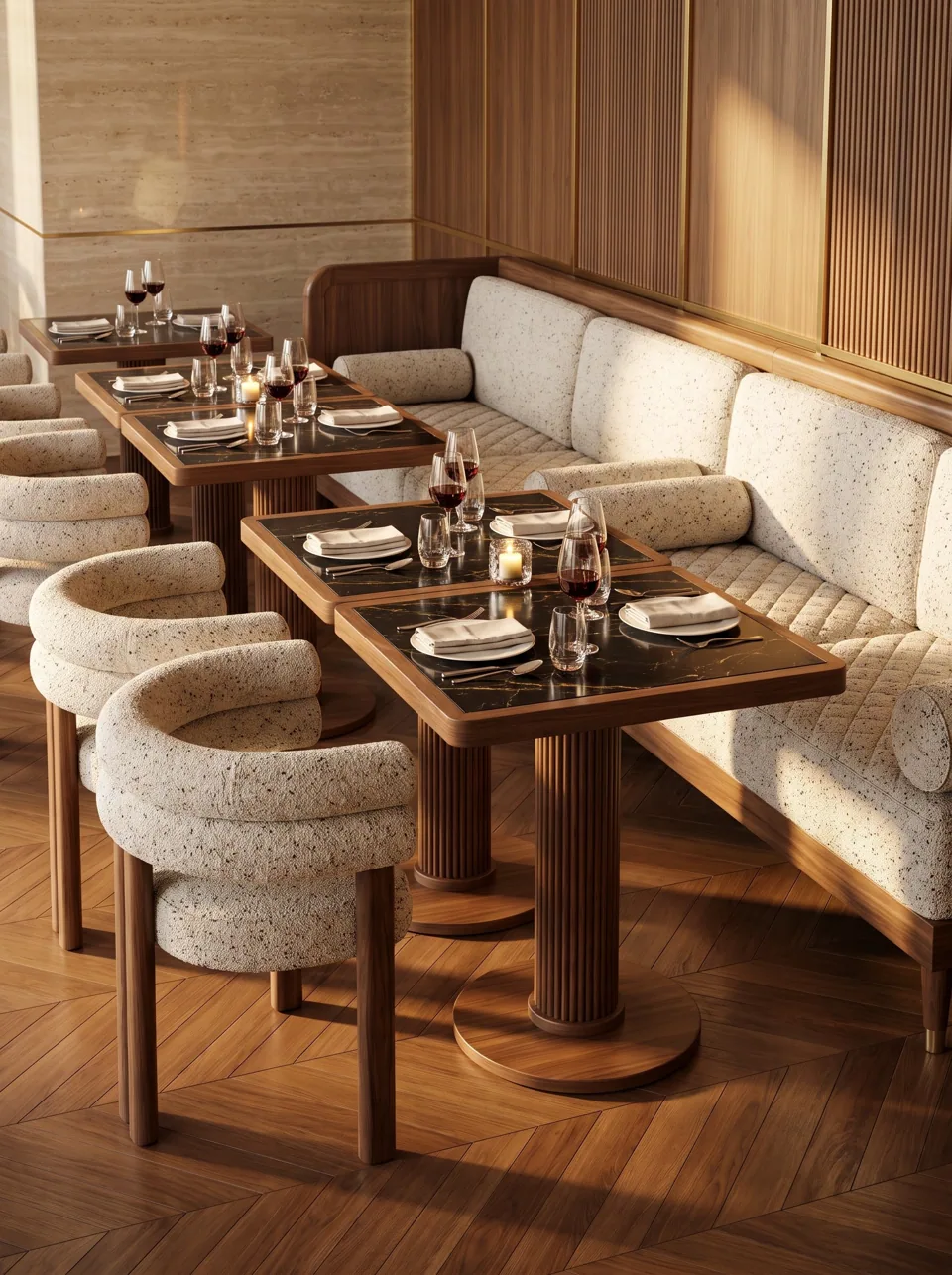
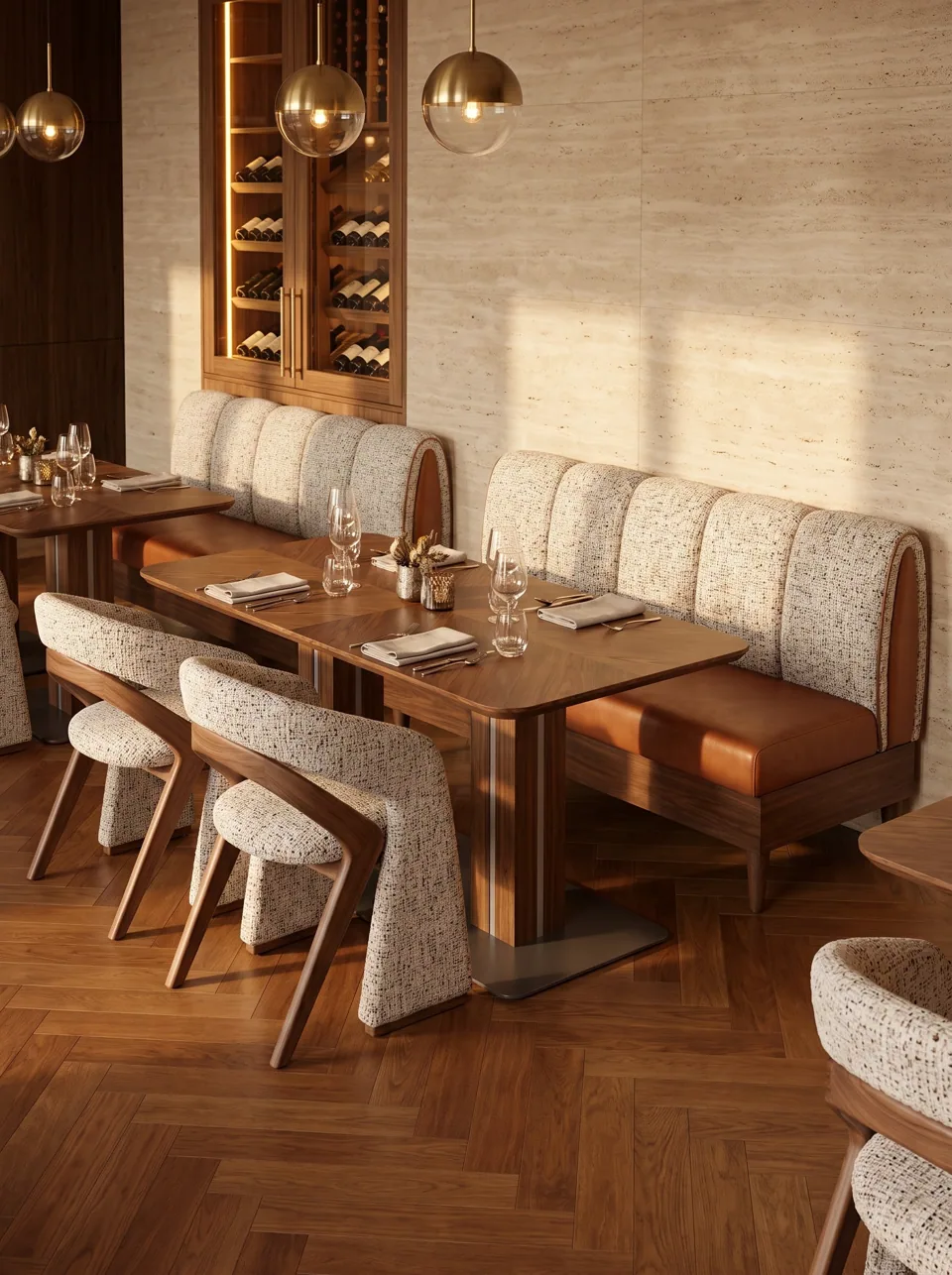
How to Calculate COM Yardage for Banquettes and Chairs (2026 Method)
A step-by-step method for calculating COM fabric and COL leather for banquettes and chairs: 54 in widths, railroaded vs up-the-bolt, repeats, worked tables.
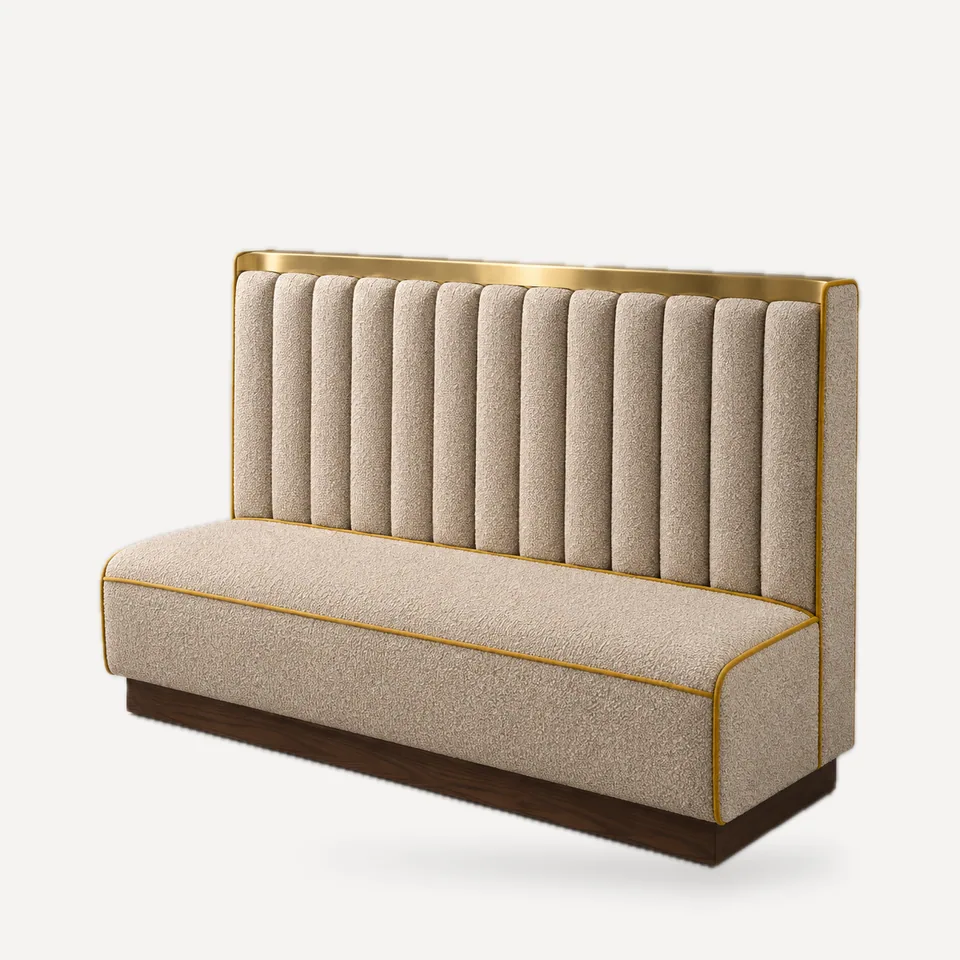
Short answer: Calculate COM by laying out every upholstered piece, with its wrap and seam allowances, on a 54 in (137 cm) fabric width, then add pattern repeat and 10 percent overage. As a planning figure, a plain-fabric wall banquette with upholstered seat, back and seat front uses roughly 0.7-0.8 yd per linear foot when railroaded; patterned fabric run up the bolt can need 50 percent more. Always order against the manufacturer's cut-plan figure, not a rule of thumb.
COM - customer's own material - is where many seating packages go wrong. Order too little and the job stops while a second dye lot is chased; order too much and the client pays for fabric that sits in a warehouse. This guide sets out the method we use at Spec Seating (a line by EASEN Commercial Furniture) to calculate COM and COL, with a worked banquette example you can adapt.
What information do you need before calculating COM?
You need five things from the specification and the fabric's data sheet:
- Usable width. Most contract upholstery is 54 in (137 cm) wide; some is narrower (for example 51-52 in) or wider for railroaded goods. Use the usable width, excluding selvedge.
- Direction. Is the fabric up the bolt (pattern reads correctly when the roll runs vertically on the furniture) or railroaded (pattern turned 90 degrees so the roll length runs horizontally)? Many plains can be used either way; most patterns cannot.
- Pattern repeat. Vertical repeat (along the roll) and horizontal repeat (across the width), in inches or centimeters.
- Piece geometry. The finished dimensions of each upholstered face, from the shop drawing.
- Construction allowances. How much fabric wraps around edges, tucks into the seat-back crease and is lost in seams.
Without the shop drawing, any figure is an estimate. That is why we put COM quantities on the drawing itself.
Step 1: List the upholstered pieces with cut sizes
Take each visible face and add allowances to get the cut size. Typical allowances for a commercial banquette:
| Allowance | Typical amount |
|---|---|
| Seam allowance | 0.5 in (13 mm) per sewn edge |
| Wrap over front edge or top roll | 3-4 in (8-10 cm) |
| Tuck into seat-back crease | 3 in (8 cm) |
| Staple return at ends of a section | 3 in (8 cm) per end |
| Welt (piping) strips | 1.5-2 in (38-50 mm) wide each |
For our worked example - a 120 in (10 ft / 305 cm) wall banquette, seat depth 22 in, cushion thickness 4 in, upholstered back face 20 in tall, upholstered seat front 10 in tall, two exposed end panels - the cut list is:
| Piece | Finished size | Cut height (across the run) | Cut length (along the run) | Qty |
|---|---|---|---|---|
| Seat top + front edge | 22 in deep + 4 in drop | 22 + 4 + 3 tuck + 1 seam = 30 in | 120 + 6 = 126 in | 1 |
| Inside back | 20 in | 20 + 3 roll + 3 tuck + 1 = 27 in | 126 in | 1 |
| Seat front (box face) | 10 in | 10 + 2 = 12 in | 126 in | 1 |
| End panels | 22 x 38 in | 24 in wide | 40 in tall | 2 |
Step 2: Lay the pieces out railroaded
Railroaded fabric lets you cut the long pieces in one length, with no vertical seams. The 54 in width runs vertically on the banquette, so pieces stack across the width:
- Strip A: seat (30 in) + seat front (12 in) = 42 in of the 54 in width, 126 in long. The 12 in remainder yields welt strips.
- Strip B: inside back (27 in), 126 in long. The 27 in remainder holds both end panels (24 in wide, 2 x 40 in = 80 in of length).
Two strips of 126 in = 252 in = 7.0 yd net. Add 10 percent overage for flaws, cutting errors and attic stock and round up: order 8 yd. That is 0.8 yd per linear foot, which is why 0.7-0.8 yd/ft is a reasonable planning figure for plain railroaded banquettes of this profile.
Step 3: Lay the pieces out up the bolt
Up-the-bolt fabric must run vertically, so the 54 in width runs along the banquette and long pieces are seamed. Each width gives about 52 in after two 0.5 in seam allowances and some margin; covering 126 in needs three widths per piece.
- Seat: 3 cuts x 30 in = 90 in
- Inside back: 3 cuts x 27 in = 81 in
- Seat front: 3 cuts x 12 in = 36 in
- End panels: both fit side by side across one width, 1 cut x 40 in = 40 in
- Welt: one 18 in cut, slit into strips = 18 in
Total 265 in = 7.4 yd net, about 8.25 yd with overage. Note what the client gets for similar yardage: two vertical seams on the seat, the back and the seat front. On a channel-back design, we place those seams in channel lines so they disappear.
Step 4: Add pattern repeat
Pattern repeat is where yardage climbs. With a 27 in vertical repeat, every up-the-bolt cut must start at the same point in the pattern, so each cut rounds up to the next whole repeat:
- Seat 30 in becomes 54 in (two repeats) x 3 = 162 in
- Inside back 27 in stays 27 in x 3 = 81 in
- Seat front 12 in becomes 27 in x 3 = 81 in
- End panels 40 in becomes 54 in = 54 in
- One extra repeat to position the first cut = 27 in, plus welt 18 in
Total 423 in = 11.75 yd net, about 13 yd with overage.
Railroaded with a 27 in repeat (now running horizontally along the banquette), each long strip needs one extra repeat so the pattern can be centered and matched at section joints: 2 x (126 + 27) = 306 in = 8.5 yd net, about 9.5 yd ordered.
Summary: the same banquette four ways
| Fabric and direction | Net yardage | Order (incl. ~10%) | Visible vertical seams |
|---|---|---|---|
| Plain, railroaded | 7.0 yd | 8 yd | None |
| Plain, up the bolt | 7.4 yd | 8.25 yd | 2 per face |
| 27 in repeat, railroaded | 8.5 yd | 9.5 yd | None |
| 27 in repeat, up the bolt | 11.75 yd | 13 yd | 2 per face, pattern matched |
The lesson: direction and repeat can change the order quantity by more than 50 percent for the same piece of furniture. Settle them before the schedule is issued.
How much COM do chairs need?
Chairs are calculated the same way, but because the pieces are small, the result is dominated by how efficiently pieces nest across the width. Planning ranges for plain 54 in fabric:
| Chair type | Typical COM (plain 54 in) |
|---|---|
| Drop-in seat pad only | 0.5-0.75 yd |
| Upholstered seat and inside back | 1-1.5 yd |
| Fully upholstered dining side chair | 2-3 yd |
| Upholstered dining armchair | 2.5-3.5 yd |
| Tub or barrel lounge chair | 4-6 yd |
| Club chair with loose seat cushion | 5-8 yd |
For large quantities of chairs, ask the manufacturer for a nested cut plan: once pieces from several chairs share the width, the per-chair figure often drops. Our COM/COL chairs each carry an item-specific figure on the shop drawing, and the SC-205 Cane-Back Side Chair shows how a removable seat pad keeps re-covering quantities small.
How do you calculate COL leather?
Leather is sold by the hide and measured in square feet. Calculate the net area of all pieces, then add a waste factor for natural defects, hide shape and grain direction - typically 25-35 percent for upholstery. In the banquette example above, net area is about 74 sq ft, so plan on roughly 95-100 sq ft. Cowhides commonly run around 45-55 sq ft, but the usable length of a single piece is limited by the hide, so long banquette seats in leather are seamed or channelled at intervals regardless of how much leather you buy. Our Continuum Run Banquette places those seams on a regular rhythm so they read as design.
Checklist before you issue the COM order
- Fabric width confirmed from the mill's data sheet (usable width, not overall)
- Direction stated on the schedule: railroaded or up the bolt
- Vertical and horizontal repeat recorded, plus any half-drop
- Pattern placement agreed (centered on seat, matched at joints)
- Welt fabric identified - self or contrast - and quantified separately if contrast
- Manufacturer's COM figure taken from the approved shop drawing
- Overage added (10 percent is common; more for small orders or difficult patterns)
- Single dye lot requested for the whole quantity
- Sidemark prepared: project, PO number, line item, quantity, ship-to
- Backing specified if needed (for example acrylic latex backing for loosely woven fabrics)
Common mistakes
- Calculating from the elevation only. Elevations show the face; they do not show wraps, tucks and returns, which can add 20-30 percent.
- Ignoring direction. Specifying a patterned up-the-bolt fabric for a long banquette and discovering at cutting stage that it must be seamed every 52 in.
- Forgetting contrast welt. It is easy to omit the second fabric entirely from the order.
- Splitting dye lots. Ordering a top-up later almost guarantees a shade difference between sections.
- No overage. Flaws are found during cutting; without spare fabric the job stops.
- Shipping COM without sidemarks. Unlabelled rolls arriving at a factory with several jobs in progress cause delays.
FAQ
What is the standard width of upholstery fabric?
Most contract upholstery fabric is 54 in (137 cm) wide. Some are narrower, and some railroaded goods are wider so that a banquette back can be cut in one piece across the width. Always use the usable width from the mill's specification.
Is railroaded fabric always cheaper for banquettes?
Not always in yardage, but almost always in appearance. For plain fabric the yardage is similar either way; for patterned fabric railroading usually saves material on long runs and eliminates vertical seams. The pattern has to look right when turned, which is why many patterns are offered in both directions.
How much overage should we order?
Ten percent is a common allowance on larger orders. For small quantities, large repeats or fabrics with frequent flaws, 15 percent is safer. Spare fabric left after production is useful attic stock for future repairs.
Where should COM be shipped for Spec Seating orders?
To our production base in Lecong, Foshan, China, with a sidemark showing project, order number, line item and quantity. We inspect and confirm receipt before cutting. If an international material shipment is impractical, we can source contract fabric on request.
Send your drawings package or FF&E schedule and we will return a scope review, quote and first shop drawings. Partial packages are fine; tell us what is still in design.
Request a quote